I'm barely out of my tube -taken out of hypersleep from which I'm hardly recovering- when the ship intercepts a communication between some men; strangely, I understand their language whereas it
sounds so different from mine. There're speaking a lot about "music"... What can it be? Perhaps one of those ancient means of expression of which there are still some traces, but that everyone
forgot the deep meaning.
First, congratulations for this new album. I think there has been quite a progression since your first one 3 years ago; what happened in the meantime, and how do you feel
about this transition from one to the other?
Thank you. Our first album was the result of the very first tracks we composed as Ætheria Conscientia. We started the band with the desire to create music that sounds like us and that
mixes all our influences, without being limited to the codes predefined by such or such genre that we appreciate, all wrapped in a science fiction universe that all of us have always
been fond of.
So Tales from Hydhradh laid the foundation for both our music and the band. For Corrupted Pillars of Vanity, we wanted to push all aspects of the first album further,
so we worked hard for 3 years to achieve this result. We jammed a lot around the songs, worked on the arrangements, the concepts and the production in order to achieve a result that
met our expectations. We have all changed a lot on a personal level during this time, our musical influences have diversified and our vision of our work has refined, which inevitably
influenced the writing of this second album.
We had a version of the album ready to be recorded in early 2020, but due to health concerns from Paul, our drummer, we had to rework the album in order to cope with these new
constraints. That got us into rewriting and programming the drums, as well as adding a lot of percussion to the album, which in hindsight we are much more satisfied with than the first
version we had.
You were in other bands before, which don’t exist anymore. What do you find in this project that you didn't have before?
Our former bands allowed us to make our debut in music. They taught us to compose, to organize the life of a band, to perform onstage in front of an audience. To tell you the truth,
they especially taught us all the mistakes not to make!
We splitted them in order to create Ætheria Conscientia, with more seriousness, ambition and cohesion than we had before.
The concept album is very common in contemporary music. Which ones inspired you?
Many concept albums have inspired us! There are all the ones by Mastodon, Voivod, Magma, Giant Squid or Mare Cognitum (whose album Phobos Monolith is surely the one that
influenced the creation of the band the most). It's a way of creating that is instinctive to us, that allows us to tell a story over the duration of an album without setting limits
on ourselves. So it's naturally that we've been using this concept since Ætheria Conscientia's debut album.
For that, you created a universe 'from scratch'. How did it happen? Did you all participate, by bringing each element to it and having discussions about it?
We all have been passionate about science fiction and fantasy since childhood. We have swallowed a lot of literary, cinematographic, video game or pictorial works. Each one of us has
his favorites (Alexis is a fan of Alien and The Thing, Paul of BioShock and Fahrenheit 451, P.A. of Blade Runner and The Fly, Tristan of
Lovecraft and Asimov). Creating a science fiction universe has always been like a dream for us, and one of the primary goals of the creation of our band.
Usually, Tristan and Paul bring the basic concepts around the universe, then the four of us discuss them in order to bring in everyone's ideas and desires. Once the narrative scheme
is defined, Tristan and Paul write the lyrics of the songs from it.
Can you introduce this universe?
Its central element is the city-planet Hydhradh. It’s the new artificial Eden of mankind. It was created from a vessel, a sort of Noah's Ark supposed to harbor the Earthlings, after
hundreds of years of wandering in the vacuum of space following the abandonment of the inhospitable Earth. This new world is obviously extremely chaotic, due to the many factions and
cults that have taken place there, the absence of a defined world order, as well as the loss of almost all of the knowledge and skills acquired by humanity on Earth.
This world should be seen as a forced new departure for humanity, which as always generates selfishness, basic instincts and a thirst for profit. Each song therefore tells a part of
the history of Hydhradh, whether it’s about its creation, the rituals that take place there, like an open window on this vast and ever-developing universe.
Even your band’s name is related to it. Can you say more about it?
Ætheria Conscientia means 'ethereal consciousness'. This is the divinity of the planet Hydhradh, the artificial world around which the stories of the first two albums take place.
This name seemed appropriate to us, because even though it can be difficult to remember, it’s very significant of the universe, and it allows us to evoke a lot of themes while
avoiding being too down-to-earth or impersonal.
The first album was the cosmogony, the basis to introduce the world of Hydhradh; what approach did you have with this second album, and what musical desires did you want to express?
Exactly, the first album laid the foundations of our universe, whether for us or for the listeners. Once those foundations laid, we were able to consolidate this universe and create
a story in it to open a window to the world. It seemed important for us to create different scales, in terms of chronology, power struggles and relationships. This narrative approach
allows us to tune different musical elements, such as doom metal influences or more experimental parts with the lyrics chanted over them.
It was important for us to push to the maximum the musical and conceptual ideas developed on Tales from Hydhradh, without repeating them. We had a better idea of where we wanted
to take our music, varying the moods and working a lot more on the arrangements and production.
Did the music come after the story, much like the score for a movie? Did you have any parts ready before that?
The band's music has always been linked to the universe that we develop. Both elements therefore influence each other naturally. We had some musical ideas already in place when
we started working on the history of the album. The first song we wrote for Corrupted Pillars of Vanity was "Asporhos’ altering Odyssey ", the opening song. It allowed us to
make a link with the previous album, while introducing new elements into the story, and therefore to set up the events developed in the rest of the album.
The story must have helped you 'chapter' and structure the album?
Indeed, the narrative elements allow us to coherently structure the album, but also the songs themselves. The longest songs are naturally those narrating quests or 'historical'
elements, while the shorter songs allow you to focus on a precise element: in the case of "Liturgy for the Ekzunreh", it's about an important ritual in Hydhradh society.
The artwork made by Amaury Pottier fits really well, and it helps project immediately into your world. I would even say that it catches the eye and makes you want to know more.
When did he get into it, and how did you collaborate with him?
Amaury has been close to Alexis and Paul for many years. It was therefore natural that his name was proposed to illustrate our first album, Tales from Hydhradh. He is
passionate about science fiction and fantasy too. He was able to stick perfectly to the spirit of our music and our universe. His works really add something to the albums, anchoring
the spatial and chaotic moods of the universe.
When we were working on Corrupted Pillars of Vanity, we didn't even think of another illustrator because we knew he could create perfect artwork for the album. We started
talking to him when the demo work was coming to an end, so that he could soak up the music, but also the lyrics from the album. Once the specifications established, we gave him
free rein to create his illustration until we had a first black and white version, to which very few changes were made before coloring.
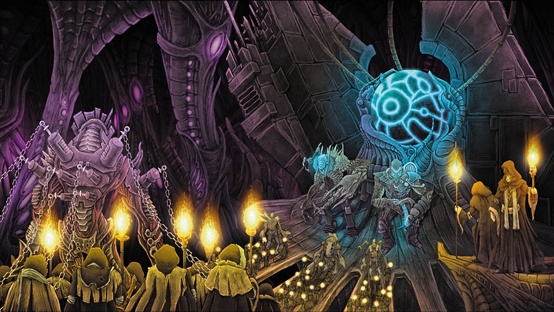
And in addition to the album artwork, Amaury also created one illustration for each song to help the listener -without too much guidance- imagine the world of Hydhradh.
Did you think of turning it into a transmedia work, with a comic book, novels or some other stuff?
The idea of transposing the universe of Ætheria to different media came to us a long time ago, but naturally it is difficult to find the time and the financial resources to do that
in a serious way. We always try to work with trusted relatives, with whom we can share our universe and who know how to represent it and bring their touch to it; it's always for the sake
of consistency, because we don’t simply wish to order something to someone from outside with whom it would be more difficult to communicate. Transmedia elements have therefore already
been discussed, we dream of adapting the universe of Ætheria Conscientia into comics or cartoons, but it’s still in the embryonic stage today.
Guests of White Ward must come from the fact that you made shows with them? So I imagine that you got along well, despite the fact that you have different universes. What do you
think of what they’re doing? (and vice versa)
We met White Ward at the end of 2019, when we followed them for two shows in Paris, then just across the Belgian border. Naturally, a collaboration came to our mind as we got along
very well, and their music has elements that are similar enough to stay cohesive and not to look like a forced addition, but also different enough to add something interesting in this
collaboration.
We like their music a lot: it’s much more urban, it has a very different approach to the jazz side from ours, with elements that seem much more inspired by Bohren & der Club of Gore,
whereas with us the progressive side is much more to find in bands like King Crimson or Enslaved.
What do you like in post-black metal? And in other musical styles? (like prog). I thought of Oranssi Pazuzu, especially for the immersive and conceptual/cinematic aspect.
Our first influences during the creation of the band were, as mentioned above, bands such as Mare Cognitum, Blut aus Nord, Voivod, Wolves in the Throne Room, and of course Oranssi
Pazuzu. Since then, we have all diversified our musical tastes and our influences can equally be found in death metal, jazz, space rock, ambient, funk, crust or even post-punk.
This theme of the cinematographic side joins the subject of concept albums, in the sense that those bands always transmit an atmosphere or a universe that goes beyond the simple sum
of the pieces.
It seems that you now want to explore other styles of music. Will you nevertheless remain in a certain continuity, or will you move on to something completely different?
Indeed, we will keep a black metal approach for the third release of the band, but we will bring other styles to our music, in order to renew ourselves and to better illustrate
the rest of the story of Ætheria Conscientia. This will require a less frontal, more aerial and psychedelic approach, thanks to other melodies, other ways of composing, other
instruments, etc. After that, perhaps we will try things more distant from black metal, because we don’t set ourselves limits.
Is this next change also due to the departure of Simon who played saxophone?
It turns out that after we composed the second album, we were in agreement to go on to something a little different for the sequel, in order to explore other sounds. There was a lot
of work on this album in terms of arrangements and harmony between guitars, bass and saxophone, which allowed us to explore all possibilities with the latter. We don't want to do
Corrupted Pillars of Vanity 2.
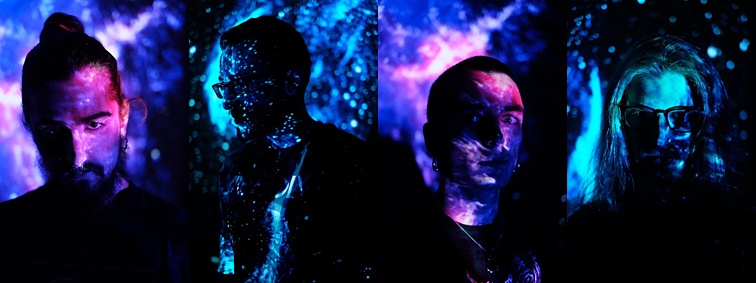
Simon's exclusion came later, and it had nothing to do with this new musical choice. We are four now, and we already know who we're going to collaborate with for the next album.
Expect new unconventional instruments in our musical style -following saxophone and congas- to continue and develop without repeating ourselves.
And as you are big fans of SF (and I guess not only that), do you have any obvious references? Is there one work -or several- that left its mark on you recently? (whatever the
medium)
In SF, we have mainly been influenced by things like the video games BioShock, the cosmic horror of Lovecraft or John Carpenter, the totalitarian drifts of Fahrenheit 451
or 1984.
Recently, Paul was stunned by the world of the Subnautica video game: the underwater world in which the game takes place is stunning in richness and immersion. The fact of
playing a lost human on this hostile planet where there are many temples created by an ancient civilization, as well as the ecological background message, spoke to him a lot.
P.A., to stay in video gaming, has been marked by the storytelling, the exploration and the world of Outer Wilds, where the origins of a lost civilization are sought in a
solar system in perpetual cycle of extinction.
Tristan was blown away by the universe created by Becky Chambers, through her one-of-a-kind novels. His benevolent and positive pen suggests new possibilities in a science fiction
that we usually know gloomy and pessimistic.
And Alexis enjoys the series The Expanse, whose story set in the 23rd century tells of an international conspiracy and imminent danger in a colonized solar system.
Mars has become a powerful and military republic, the impoverished Earth is ruled by the UN, and the Asteroid Belt is plundered by the latter two but tries to rebel. In his other
references, there are the works of director Andrew Niccol such as Gattaca or more recently Anon.
Thanks, I can't wait to hear what’s next, and why not see you on stage?
Thank you to you for this interview, and for your interest in our work!