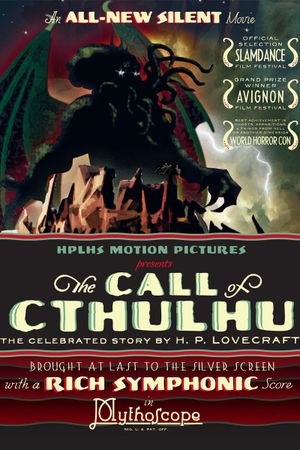
The first adaptation -in the form of a medium length film- of The Call of Cthulhu (a short story written in 1928 by Howard Phillips Lovecraft), we owe it to a group of people fascinated by the recluse of Providence.
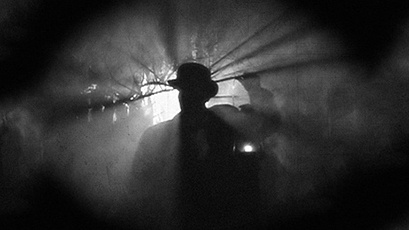
Sometimes, you are never served better than by yourself... But attention, to stick as best as possible to the period, this is a silent film (with the excessive acting that goes with it), which also includes tinkered special
effects. You have been warned, but that is precisely what gives it all its charm and makes it a success despite the limited means of production.
First, thank you for this interview. Can you introduce yourselves for those who don’t know you?
Andrew Leman (director): Along with Sean and Darrell Tutchton, I was one of the founders of the H.P. Lovecraft Historical Society, and I am still one of its
executive officers. I've written and run a large number of live-action Cthulhu games, and along with Sean I've written, produced and/or directed various Lovecraftian entertainment
projects. When not working on Lovecraftian things, I design fonts, I am occasionally a professional actor, and I used to work as a fossil preparator at the Field Museum of Natural
History in Chicago.
Sean Branney (screenwriter): Andrew and I are longtime friends. We're both fans of Lovecraft and we created Cthulhu lives, our
own style of live action role playing. We both have backgrounds in theatre. I run a theatre company in Los Angeles, and these days I spend most of my time working for the HPLHS.
Andrew and I have collaborated on many projects including live games, CDs, books, screenplays and movies.
The Call of Cthulhu was made in a DIY way, but with professionals. Is it alright said like that?
Andrew: Nearly everyone involved in making the movie has professional experience in film and/or live theatre. Many members of our cast have appeared on
film and television, and in numerous stage plays. Sean and I both have Master of Fine Arts degrees in theatre and years of professional experience. At the same time, none of us had
ever worked on an old-fashioned silent film before, and we were using techniques that were new to most of us. I think everyone involved learned some new skills or had some new
experience.
Sean: Indeed most of the people involved with The Call of Cthulhu are professionals at what they do. We were fortunate that they are friends of ours, and were
willing to work on such a low-budget project. We had to DIY for many elements of the production. We are pretty happy with how the film turned out, despite any limitations we had
in how we made the movie.
What were your choices to represent the universe of Lovecraft? Did you succeed in what you expected?
Andrew: Our main choices were to be as faithful to Lovecraft's descriptions and his time period as we possibly could, within the severe limitations of our resources. We
tried to capture the aesthetic of 1920's filmmaking with lighting, composition, camera movement and staging. We used authentic period props and costumes wherever possible, and
we worked hard to avoid anachronistic elements. We shot on location at the actual Fleur de Lys Studio in Providence, Rhode Island, a real building that Lovecraft mentions by name in
the story. For the design of the swamp, R'lyeh and dream scenes, we were inspired by the work of Lovecraft's own favorite artists, along with other painters who lived and worked in
the 1920's, including Lyonel Feininger and M. C. Escher. The exterior shots seen during the travel sequence are taken from real vintage movie clips, and most of them show the
actual places they represent. And even the handwriting seen in the closing shot of the film is a replica of Lovecraft's own handwriting. Considering our limited resources, I think
we represented his world as well as we could.
Sean: In Lovecraft stories, characters are rarely significant. There tends to be few significant relationships and very little dialogue. The characters often tend
to be insignificant to the overall story. We felt it was important not to introduce elements to the story (such as a girlfriend, a villain, etc.) which would not be in keeping with
the nature of Lovecraft's writing. Certainly from a visual point of view, we tried to make the film look historically accurate for the time in which HPL lived.
The 'Mythoscope' was a brilliant idea! How did it happen? Did you watch a lot of silent movies, and did you find a model?
Sean: We were discussing the idea of making The Call of Cthulhu, and saw a great short film shot in an antique style. That got us talking about all the
advantages of shooting this movie as if it had been made in the 1920's. Andrew and David Robertson, our cinematographer, did a lot of work to capture the visual style of many of
the greatest silent films.
Andrew: We did study a lot of silent movies, including Metropolis, Nosferatu, The Cabinet of Dr. Caligari, Faust, The Thief of Baghdad,
The Phantom of the Opera, Sunrise, Destiny and many others. We found something inspiring in each of them, and didn't have any one particular model. Our
brilliant cinematographer and editor David developed a custom formula for making our crisp color video footage look like old black and white film with a combination of
good lighting, color correction, layer compositing, and digital filters.
What time and money required The Call of Cthulhu? Did you find some difficulties in the project?
Andrew: We spent about 18 months making the film. We didn't make an official budget or keep close track of the money involved, but in the end we spent around $50,000. As
for difficulties, yes there were any number of them. Scheduling filming and finding locations were both difficult. Building sets required vast amounts of time and labor. In fact,
very few things about this project were easy.
Sean: There were challenges everywhere we turned, but none proved impossible. Getting an authentic pre-World War I paddy wagon was a big challenge, but somehow we
managed to borrow one and shoot it. We had to fire our composer near the end of the project, because he hadn't written any music, so getting the score was a challenge. It was
challenging to work with such a large cast, with so many locations and over such a long period of time. Fortunately, our cast and crew are lovely people, and they made the process
about as easy as one could hope for.
Didn't you apprehend the reaction of Lovecraft fans? What's the general feeling now that the movie was released?
Andrew: We felt reasonably confident that fans would enjoy it, because we're fans ourselves and we know this is the kind of movie we've been craving for years. The
film has been more favorably received than we expected, and we're extremely happy that people seem to enjoy it so much.
Sean: We made the movie the way we thought it should be made, and we hoped other people would like it. We have been pleasantly surprised that the film has been so
strongly embraced by Lovecraft fans, silent film fans and movie-goers all over the world. We've also been delighted that film festivals across the globe have show interest in the
movie, and it has screened all over the US and in many other countries. The movie recently won the Jameson Audience Choice Award at the Århus Festival of Independent Arts in
Denmark.
Do you have any regret, would you change something in the movie?
Andrew: Personally, I don't have any regrets, although there are a few things I would do differently if I had a chance to do them again. And if we had a real movie budget,
I know there are things we would like to have done better: film with a real boat, for example, and build a better full-size set of R'lyeh.
Sean: There's a couple of things that we might have done differently if we had more time or money. For me, I would like to have staged and shot the fights in the
swamp scene differently. I would also have liked to have included one more angle of The Alert ramming Cthulhu. It's hard to be a filmmaker and be 100% happy with every moment in a
movie, but both Andrew and I were very pleased with how this movie turned out.
John Carpenter and Stuart Gordon are famous for their homage to Lovecraft. Do you think that an adaptation both modern and faithful to Lovecraft is
possible?
Andrew: Certainly I think it's possible, but I think it has to be carefully handled. Adaptation is always a difficult job, if you want to do it right, anyway.
Sean: Me too, I absolutely think it's possible. It just requires someone to really try to be both modern and faithful. Oh yes, and they have to convince someone
else to pay for such a movie (that's the hardest part).
Would you like to do a documentary about the Lovecraft world?
Sean: We did a mockumentary film called A Shoggoth on the Roof a few years ago. More recently, Andrew appeared in a documentary called The Eldritch
Influence. We have yet to shoot a true documentary.
Andrew: We haven't made a film documentary, but we do have quite a bit of content on our website on the history of the 1920's and 1930's, along
with articles from our old journal Strange Eons, which discuss various aspects of Lovecraft's fiction and its derivatives.
In France, many studies were done and books published about Lovecraft since the 1970's. Do all the subtitles in the DVD of the film mean that there's
still a large demand from all around the world for Lovecraft?
Andrew: Lovecraft has fans all over the world. We've found interest particularly high in Scandinavia, but he is greatly appreciated in France, Germany, the U.K. and
elsewhere.
Sean: The Lovecraft community is global. Our website gets tons of visitors from Europe, Australia, New Zealand, North America and South America. We see some from
Asia, very few from the Middle East and very few from Africa. We sent almost half of the DVDs of The Call of Cthulhu outside the USA. Hopefully, having all those languages
makes the movie accessible to more people.
Finally, what's your point of view about the fact that a lot of people think that the Necronomicon really exists? I find that it's
amazing.
Andrew: Sometimes, the bigger a lie is, the more people believe it. Lovecraft's creation of the Necronomicon doesn't amount to a lie, exactly, but it has certainly
been well amplified over a great number of years by many different people. That there should be such a book is an appealing idea, and no doubt a lot of people would rather believe
that it's real than that HPL made it up.
Sean: While Lovecraft created the Necronomicon, I think it seems real because there are real books like it. The real occult tomes, particularly from the
Renaissance era, are very strange, very difficult reading. The great thing to me about the Necronomicon is that even if it isn't true, it seems like it should be true.
Thank you very much! A last word?
Sean: We appreciate your interest in our work, and thank you for telling your readers about this strange project of ours.